

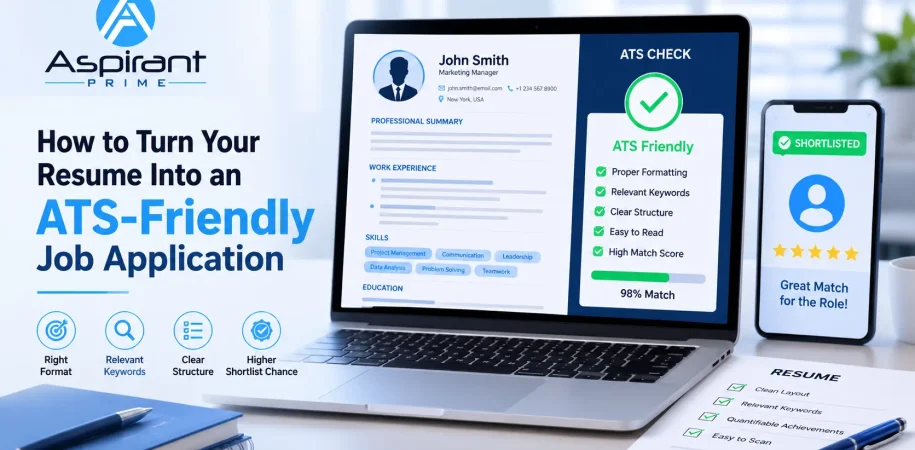

Most job seekers have heard some version of the same warning: a resume is probably getting rejected by a robot before a human ever lays eyes on it. It gets repeated so often that people just take it as fact, and it’s pushed a lot of resume writing into strange, keyword-stuffed territory, producing documents that read worse to a hiring manager than they would have without the “optimization.” At Aspirant Prime, working as a leading recruitment firm in USA, we sit on both sides of this. We see the resumes candidates send in, and we see what happens to them once they land inside a company’s hiring system. Those two things don’t always line up with the popular story.
This piece gets into what applicant tracking systems really do, where the common advice goes sideways, and what actually moves the needle, both with the software and with whoever reads the resume after that.
Time to Retire the “75% Rejected by Robots” Line
The stat that keeps getting repeated, that roughly three out of four resumes get rejected by ATS software before a human ever sees them, falls apart pretty quickly once you look into where it came from. It traces back to a 2012 sales pitch from a company called Preptel, which sold resume optimization services and shut down the following year without ever publishing a methodology behind the number. More recent reporting, including interviews with practicing recruiters conducted by the resume platform Enhancv in late 2025, points to something closer to the opposite: most ATS platforms don’t auto-reject resumes based on content at all. They organize and rank applications so a person can get through them faster.
That doesn’t mean formatting and keywords are irrelevant. They’re not. It just means the mechanism works differently than most job seekers have been told, and knowing the real mechanism leads to better decisions than chasing a myth around.
What’s Really Happening Inside an ATS
An applicant tracking system is software that reads a submitted resume, pulls out structured information like job titles, dates, and skills, and stores it alongside every other application for that role. Most systems then score or rank candidates against the job requisition, so a recruiter can get through a stack of two hundred applications faster than reading each one cold. Think of it as a filing and ranking tool first. It’s not some judge quietly handing down rejections on its own.
What actually screens people out before anyone looks at anything is usually a set of knockout questions the employer configured directly: does the candidate have the right to work in the country, do they meet a minimum years-of-experience requirement, are they willing to relocate. Those are deliberate calls made by the hiring team, not a hidden penalty for using the wrong font.
Formatting That Helps, and Formatting That Sabotages You
Even with auto-rejection mostly off the table, formatting still affects how accurately a resume gets parsed, and a badly parsed resume can look incomplete or garbled by the time a recruiter opens it.
Tables and multi-column layouts cause a lot of the trouble. Some systems read them out of order or skip sections entirely, so a nicely designed two-column resume can show up on the recruiter’s end with the skills section merged awkwardly into the middle of the work history. Small icons in place of plain text cause a quieter version of the same problem, since a phone number or email address can disappear right along with the image if the parser can’t read it.
Headers and footers are another trap. A lot of systems just ignore them, so anything critical, name, phone number, current title, needs to live in the main body instead of tucked up top where it might never get picked up. Text boxes cause trouble too, probably more than people realize: content dropped into one instead of the normal document flow often doesn’t survive the parse at all, which is how a resume ends up looking oddly incomplete for no obvious reason.
A clean, single-column layout with standard section titles, Experience, Education, Skills, Certifications, tends to parse the most reliably across different systems. It also happens to be easier for a human to skim in the fifteen or twenty seconds most recruiters spend on a first pass, so the same choice ends up helping on both ends.
The Right Way to Think About Keywords
Cramming a resume with every possible keyword from a job description, sometimes literally in white text on a white background so it’s invisible to a human reader but supposedly visible to the software, is advice that’s aged badly. Modern parsers can detect hidden text, and getting caught doesn’t help an application. It flags it.
What works instead is a lot more straightforward, and a lot less sketchy: read the job description closely and mirror its language wherever it’s genuinely true to the candidate’s background. If a posting asks for experience with “customer relationship management software” and the resume only says “CRM,” write both out somewhere in the document. If a role calls for “accounts payable” experience, that phrase should show up if the candidate has really done that work, rather than a nearby synonym a human would understand but a keyword match might miss. This isn’t about tricking anyone. It’s about using the same words the employer used, since that’s the plainest way to show the fit is real.
Tailoring a resume per application, even in small ways, beats sending one static version to everything. It takes more time, but it consistently outperforms a single document trying to be everything to everyone.
Passing the Software Isn’t the Finish Line
None of the formatting advice matters much if the resume itself is thin once a person sits down and reads it. It is not enough that a document parses successfully if it contains phrases like “responsible for various tasks” and “result-driven team player.” Quantifiable achievements – managed a $2 million budget, reduced processing time by 30 percent, and managed a team of eleven people – tell the hiring manager something that those generic terms never will.
Training and certifications deserve the same treatment. Someone who’s completed Data Analyst training in USA, earned a Business Analyst certification, or worked through Cloud Computing or SQL training should list it plainly, not fold it into a vague “proficient in various tools” line. Concrete credentials read as concrete to a parser and to a person alike.
Seniority level should shape the language too. A resume for a director-level role that reads like an entry-level job description undersells the candidate, and the reverse is just as obvious. Getting past the software was never the point. The point was always a fair read from the person who makes the decision.
Why Going Through a Recruiter Changes the Odds
A resume submitted cold through a company’s careers page still has to clear whatever process that employer has set up, ATS included. One submitted through a recruiter often takes a different path entirely, landing directly with a hiring manager who already trusts the source. That’s a big part of what a best recruitment agency in USA offers beyond the initial match: a way past the general applicant pool, plus honest feedback on how a resume reads before it ever gets submitted anywhere.
Aspirant Prime works as a top hiring agency in USA across specific sectors, which means we tend to know exactly what a given employer’s screening process looks like and what their hiring managers actually respond to, a different kind of insight than any generic resume template can offer. Day to day, that shows up in how we match candidates across Information Technology, Finance & Administration, Medical & Pharma, Consumer Products, and Supply Chain & Logistics.
It shows up on the training side too. Aspirant Prime runs programs in Data Analyst training, Java training, Business Analyst certification, and SQL training in USA, and candidates who go through them tend to walk away with a resume backed by real, specific experience instead of a keyword bolted on because a posting happened to mention it. A resume built on real training just holds up better than one built on guesswork about what an employer wants to hear.
So What Actually Moves the Needle
The fear behind a lot of resume advice, that some invisible algorithm is silently tossing out most applications, is largely built on a number that was never real to begin with. The more accurate picture is less dramatic, and honestly a lot more useful.
Write the content in such a manner that the software is able to read your work as it should be. Use language that fits the context rather than fillers. Apart from that, it all comes down to having something that will not disappoint when reviewed by an actual person.
Candidates who want a second opinion on how a resume is likely to land, or who want to understand how a specific employer’s process works, are welcome to reach out to Aspirant Prime. Support runs across all five industries we work in, with one goal: getting the right resume in front of the right person, not just past a piece of software
Frequently Asked Questions
Q. Should a resume be submitted as a PDF or a Word document?
PDF works well for most systems out there, as long as it’s a genuine text-based PDF rather than an image of text saved as one. A few older, clunkier ATS platforms parse Word documents better, so if a posting specifies a format, follow that. If nothing’s specified, PDF is the safer bet since it shows up exactly as intended.
Q. Does resume length affect how well it parses?
That’s not really the case, I don’t think. It’s a human issue more than a software issue. The recruiters glance through your resume for probably about fifteen seconds, and in those three pages, the only two relevant lines are buried under an old internship. One to two pages covers most people fine. Someone twenty years into a technical or executive career can reasonably run longer, since there’s simply more relevant ground to cover.
Q. Are online ATS resume checkers worth using before applying?
For catching the obvious stuff, sure, a missing section header, text trapped inside a table, that kind of thing. Where they oversell themselves is the tidy percentage score at the end. No outside tool can see inside a specific company’s actual hiring setup, so treat that number as a rough gut check, not something to chase toward 100.
Q. If a recruiter submits my resume, does it skip the ATS entirely?
Usually not. Most agencies still run candidates through the employer’s own system like anyone else would. What’s different is the context riding along with it. A resume that arrives alongside a phone call from someone the hiring manager already trusts tends to get noticed, no matter where it lands in the system.
Q. Is it really necessary to customize a resume for every single application?
No, not a complete rewrite. However, taking a few moments to make sure that the most relevant achievement is at the top, and changing the wording to match the actual posting, is much better than one generic rewrite for the week’s dozen postings. It’s an easy thing to neglect when sending out a half dozen applications a day, but a dead giveaway to the recruiter who receives them.